
Oddities and Questions
When considering Risk Lord of the Rings game, one must examine the game on two levels: as a mass market game and where the game resides in the family of Risk games. There were some strange events that accompanied Risk LotR. First, there were two major releases: The Middle Earth Conquest game (aka The Two Towers game) following the second movie and the Trilogy edition following the third movie in the series. The Trilogy edition expanded the map by nearly 50% adding Mount Doom and other places so familiar. In addition to these two releases, the version published in Great Britain included a two player variant (The Siege of Minas Tirith) designed by Richard Borg (Battle Cry, Memoir 44) with an additional map. This variant has not appeared in any of the North American releases. Some of the editions of the game were supplied with a metal, gold colored ring for the turn marker and others simply received a counter. Finally, the suggested age for playing the game was listed as 9+; the youngest of any game in the Risk family (implying that the game was easier to learn and play than classic Risk)!
Some of these oddities are understandable and can generally be attributed to marketing decisions. Lowering the suggested age simply increased the potential market for those unaware of the actual complexity. The Two Towers edition, the first of the two releases, truncated the board as the license forbid revealing details of the yet-to-be-released third movie in the series. Hasbro/Parker Brothers was faced with delaying publication for another year (potentially losing sales) or releasing it with the hopped off board. To their credit, once the Trilogy edition was released Hasbro provided all those who contacted them with the new map, additional counters and cards at a minimal charge. Why the North American market was deprived of the Siege if Minas Tirith variant, I cannot explain.
Both games play the same so comments made concerning one edition will apply to both unless noted. The real difference between the two games is the expansion of the board in the Trilogy edition. There are no significant differences nor has the number of players increased with the expanded board. It remains 2 to 4 players or two teams.
Map
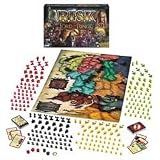
Both maps are, of course, of Middle Earth. The Two Towers map has 42 territories as in classic Risk. The Trilogy edition increases this to 64 territories. Unlike the original game, LotR Risk includes terrain that blocks movement. (This appears in Risk Godstorm also.) Various mountains and rivers segregate the territories rendering some significantly more valuable than others. Bridges over rivers provide the only means for crossing and the combination of mountains and rivers increases the strategic decisions required by the player. The bridges and the mountain passes can be a path to victory or result in a bottleneck that retards progress.
There is a series of mountain ranges that parades down the center of the board with only a few gaps between the East and West sides of the map. These areas are critical junctions in the Two Towers version and only slightly less significant in the Trilogy edition (there are alternatives in the Trilogy edition due to the additional territories). To cross from East to West (or the reverse) units must pass through Forodwaith, Moria, Carrock or the Gap of Rohan - there simply are no other routes (again, the Trilogy edition does include other methods). These are key points on the map and control over them can be critical.
Along the West side of the map are sea routes that allow for the rapid deployment of troops. There are three ports on the Two Towers map and five on the Trilogy edition map. Controlling the ports is strategically significant as they provide a threat to vast areas of the map. (This is somewhat reminiscent of Castle Risk only the implementation is superior.)
Located in various territories are Strongholds (in gold) and Sites of Power (in black). The Strongholds aid in defense increasing the defender's die roll by +1. Each Stronghold is worth 2 victory points at the end of the game. The Sites of Power allow Leaders to draw adventure cards and complete missions which score points when completed.
Finally there is a dashed line that wanders down the center of the board ending in the Dead Marshes on the Two Towers map and on Mount Doom in the Trilogy edition. This is a built-in timer forcing the game to a conclusion. The `ring' represents the Fellowship and begins this journey in the Shire on both boards. Each player turn the Fellowship (ring counter) moves one territory closer to Mount Doom (or the Dead Marshes). Note: this is one space for each player; it is not one space every time all of the players have completed their moves so the game moves at a fairly quick pace. There is a minor randomizer built in to the board. Certain spaces have a die pictured. When the Fellowship reaches one of these territories, they must remain in place until they roll greater than a three. This serves to prevent the game end from becoming predictable. Warning: because the `timer' is somewhat randomized, players may not receive an equal number of turns. Of course tracking the number of remaining turns is critical and requires players to time their attacks.
I have no opinion as to whether the map is an accurate depiction of Middle Earth. (That is for Tolkien fans to judge.) As a game map it is interesting and presents challenges and isn't that what it should be?
Bits
There are two types of units in the game: armies and leaders. Hasbro provides little miniatures rather than the typical generic blocks or stars found in so many games today. It does not affect game play but does add to the theme of the game. The `Forces of Good' have three types of miniatures: Elvin Archers (1 unit), Riders of Rohan (3 units) and Eagles (5 units). The Forces of Evil are depicted as: Orcs (1 unit), Dark Riders (3 units) and Cave Trolls (5 units). The different units provide no special benefits, they are simply for `banking' purposes. This system has become standard in Risk games.
The Leader units are represented by shields and serve two purposes. Leaders are the only units that can acquire Adventure cards and are required to complete missions. If a Leader is involved in a battle, whether as attacker or a defender, a +1 is added to the highest die roll.
Combat/Reinforcements
Battles in LotR are resolved as in classic Risk style including earning territory cards. The reinforcement schedule is a restricted table unlike that of the classic game. Sets of cards have fixed values. The schedule is as follows: 3 Archers/Orcs = 4 armies, 3 Riders = 6 armies, 3 Eagles/Cave Trolls = 8 armies and one of each type produces 10 armies. The game includes a version of continental bonuses for controlling specific areas of the map that range from 2 units to 7 units. Unlike the classic game, LotR is played for points and battles serve to increase point totals not to simply eliminate other players.
Cards
Beginning with Risk 2210 and continuing through Godstorm and Clone Wars, cards have become an integral ingredient in Risk games. For some purists the cards are anathema however, I found them to substantially increase the decisions, strategy and pleasure in the game. Unfortunately, the cards in Lord of the Rings Risk simply miss the mark. Had the cards been tailored along the lines of the other versions, this could have been a first class addition to the Risk family. Had the cards been battle oriented, LotR could have dominated War of the Ring. As it stands, LotR will always be something less than it could have been.
In addition to the standard territory cards there is a second deck known as Adventure cards. The Adventure cards appear in three flavors: mission cards, event cards and power cards. These are the cards that I believe are weak.
Mission Cards - Each card specifies a certain Site of Power. When a leader reaches the appropriate Site, the card is revealed. An example of a typical mission is: Easterling Encampment: if completed by the `Evil' player or team, he receives 2 armies and 1 victory point; if completed by the `Good' player (or team) he receives 6 armies and 2 victory points. Of course the values on the cards vary.
Event Cards - These must be played immediately when drawn. The Event cards randomly provide additional armies and leaders or may even remove armies. These are unconnected to any situation on the map; these only occur when drawn. There are no victory points awarded on Event cards.
Power Cards - These cards affect battles. Some provide additional troops, reinforcements, circumvent the value of Strongholds, etc. The core of the problem I have with LotR is these particular cards. The Power cards represent about 40% of the deck and a bit over one-third of these cards do nothing more than slow down the Fellowship! (Note: if you believe that you are winning there is absolutely no reason for slowing the Fellowship; if you are not winning, then something more powerful, more valuable would have been appreciated.) The remaining cards may not enhance your abilities depending on your position. Where some have argued that the cards in Godstorm are too powerful - these are typically so weak as to be nearly useless.
In addition to this inherent weakness in the cards, LotR is won by points. Points are awarded for controlling territories, areas (continents), Strongholds and the points accumulated on cards. As playing a Power cards awards some victory points, the player must often decide between playing a Power card for the victory points but suffering the repercussions or foregoing the victory points. With the right combination of cards Risk Lord of the Ring could have been the definitive wargame on the subject matter.
Conclusion
When I began I stated that the game must be evaluated on two levels: the mass market and it's relation to other Risk games.
For the mass market consumer it is an excellent introduction to the world of Risk and is certainly more accessible than War of the Ring or some of the miniature systems. The game has a familiar theme, plays in a reasonable amount of time and is won or lost on points so players that are somewhat adverse to combat can follow other paths to obtain points.
For the occasional Risk player the game is a great addition. It is a different, interesting and improved map over the classic game and there is greater variety in the strategic possibilities. However the Risk aficionado or the player looking for a light war game maybe a bit disappointed. Allow me to make this clear - this is not a bad game, it is a good game; it simply is not what it could have been. It is inevitable that this game will be compared this War of the Ring. I enjoy everything in Risk LotR more than War of the Ring with the exception of the cards. Unfortunately, the card play in War of the Ring is significantly superior. I own both games and enjoy both. Had LotR been just a smidgen better, I would not own War of the Ring.
Finally, the game is great for team play or even as a two-player event. There are two generally accepted methods for playing, one that requires a `house rule'. As the rules are presented, unless playing teams, players are on their own as in classic Risk. This allows a `Good' or `Evil' player to attack one of his own. This works fine as a Risk game but depreciates the theme. To retain the proper theme we usually prohibit players from attacking those of their own kind. (One Evil army cannot attack the other, etc.) This has resulted in some very interesting situations and increases the complexity of the decisions confronting the players. Either method results in a fun experience.
The game was designed by Stephen Baker who designed or was part of the design team for Battle Masters, Hero Quest, Heroscape, Space Crusade and Axis & Allies Pacific. He has been credited with being an expert on miniatures.Get more detail about Risk: Lord of the Rings Edition.

0 ความคิดเห็น:
แสดงความคิดเห็น